
a. natasha joukovsky
journal
AN ENGLISH MAJOR-TURNED-CONSULTANT'S GUIDE TO RIGHT NOW
For anyone who has been having trouble keeping things straight recently.
Alternate title: Dear President Trump Please Stop Offending Not Just Reality But Also Actual Fiction
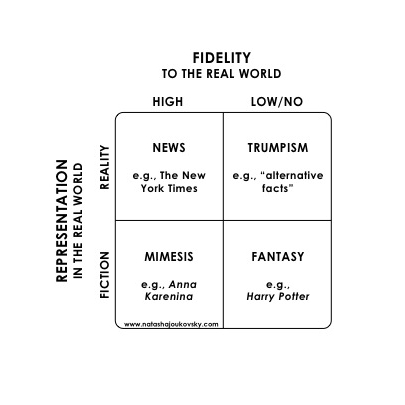
Made this for anyone who has been having trouble keeping things straight recently. As a human being, I'm offended by his assault on facts. As someone in the process of writing a novel, I'm offended by the bad name he is giving to fiction.

SELLING ANTI-CONSUMERISM
Increasingly, we see companies and individuals selling us the absence of things, selling us on negative space, on minimalism. How do you sell things when consumerism itself is passé? You sell anti-consumerism.

Full-page Patagonia ad in the New York Times published black friday, 2011.
As a subjective but real yearning for a persuasive illusion, glamour is perhaps the cornerstone of advertising and the jet fuel of consumerism. Glamour is what convinces us we want things we don't want and need things we don't need for just long enough to pull the trigger and buy things we shouldn't buy.
"Subjective" is the operative word when it comes to deliberately harnessing glamour this way, that is as a marketing tool. This is why marketers tailor to segments and demographics. Nevertheless it is possible to see macro trends. The grotesque conspicuous consumption and label-mania of the early 2000s has been, I think, gradually giving way to a more sophisticated sales pitch to more sophisticated consumers. Increasingly, we see companies and individuals selling us the absence of things, selling us on negative space, on minimalism. How do you sell things when consumerism itself is passé? You sell anti-consumerism.
Selling anti-consumerism sounds like a paradox, but it functions more like a cliché. Specifically, it's like calling out a cliché as cliché in order to use the cliché without seeming cliché--which is, of course, not a departure from the use of cliché, but the total mastery of it; the ability to bring an old, tired truism back from the dead. And when powerful things resurrect, they tend to be even more powerful than they were the first time. It's hard to argue with a cliché that doesn't seem cliché.
Calling out consumerism is an almost identically neat trick, as exposing and empathizing with consumers' gripes with consumerism creates stronger bonds of trust and loyalty than even the most ideally-targeted pro-consumption ads can.
Stripping away glamour, it turns out, has a glamour of its own. Marie Kondo's promise of spare spaces and aesthetic organization sells books (I bought one). Six years after Patagonia's "DON'T BUY THIS JACKET" black friday ad in 2011, the brand is more popular than ever (I've bought lots). There is a warm, feel-good comfort to Patagonia's fleeces beyond their soft, recycled pile in the company's commitment to environmentalism and responsible sourcing.
This starts to get near the reason why anti-consumerism is so seductive: it not only offers guilt-free purchasable pathways to the rejection of purchasing, but the ability to broadcast that ethos. In a strange kind of alchemy, material things can become signifiers of distain for materialism. It is now possible to buy something in order to show that you're above buying things. And lucrative to sell them. Just because Patagonia is probably one of the best, most ethical companies out there doesn't mean "DON'T BUY THIS JACKET" isn't clever, glamorous advertising and brand stewardship. They're selling us by selling us they're not selling us. But they're still selling us. It's not a reversal of consumerism, but rather another recursive layer embedding the will to buy where it's harder to see and probably harder to cognitively counter.
Recently my most maximalist friend sent around an article from GQ with a request for advice on developing a minimalist wardrobe. No surprise, the author's decluttering process required $5,800 of new spend, including $990 for a single cashmere sweater and $811 for two pairs of sneakers. This is starting to sound like an indictment of minimalism, which it isn't. I enjoyed Marie Kondo's book, and, as previously hinted, own a small mountain of Patagonia. But in this post-truth era of alternative facts, I think it's important to recognize this trend for what it is and unpack the glamour here all the way down to the uncomfortable truth: that anti-consumerism consumerism is still consumption, that a cliché exposed is still a cliché.

INAUGURATION 2017: SARTORIAL SUBTEXT
If you crop out Donald, it's a moving, beautiful image. Two powerful women, an African American and an immigrant, embracing one another warmly, clad in the color family of the other's party.

The Obamas and the Trumps, Inauguration Day 2017.
Melania Trump's inauguration ensemble perhaps bore an even greater debt to Jackie Kennedy's than her RNC speech did to Michelle Obama's. The internet is a-flutter with comparisons; there would have probably been even more had Kellyanne Conway not showed up dressed as Paddington Bear.

Jacqueline and John F. Kennedy at his Inauguration, 1961.
It's a move reflective of her husband's campaign's nostalgic overtones and an aggressively "I'm-the-first-lady"-looking look, and yet--intentionally, I hope--her choice can also be interpreted as an olive branch, and perhaps even subversive.
Jackie Kennedy was a democrat whose famous powder-blue suit perfectly matched her husband's tie; collectively they recognized yet muted the traditional blue of their party in the act of becoming President and First Lady of the entire American populace.
In contrast, Donald wore unadulterated Republican/MAGA red--and as a republican First Lady, the same powder blue carries different connotations. I'd read Melania's Ralph Lauren more as a Declaration of Independence from her husband if (in a coordinated effort that just had to be intentional) Michelle Obama wasn't wearing burgundy in contrast to President Obama's traditional, Democratic blue tie.

Mrs. Obama and Mrs. Trump today.
It has to be said that if you crop out Donald, it's a moving, beautiful image. Two powerful women, an African American and an immigrant, embracing one another warmly, clad in the color family of the other's party. It gives a sense of respect without deference, of a unified appeal for unity. They ooze FLOTUS glamour. It's worthy of the cover of Vogue.
It's also a sentiment that echoes Michelle's choices for both of her husband's own inaugurations. She wore yellow--the third, and only neutral, primary color--in 2009, and, along with her daughters, shades of violet in 2013--the secondary product of mixing red and blue.
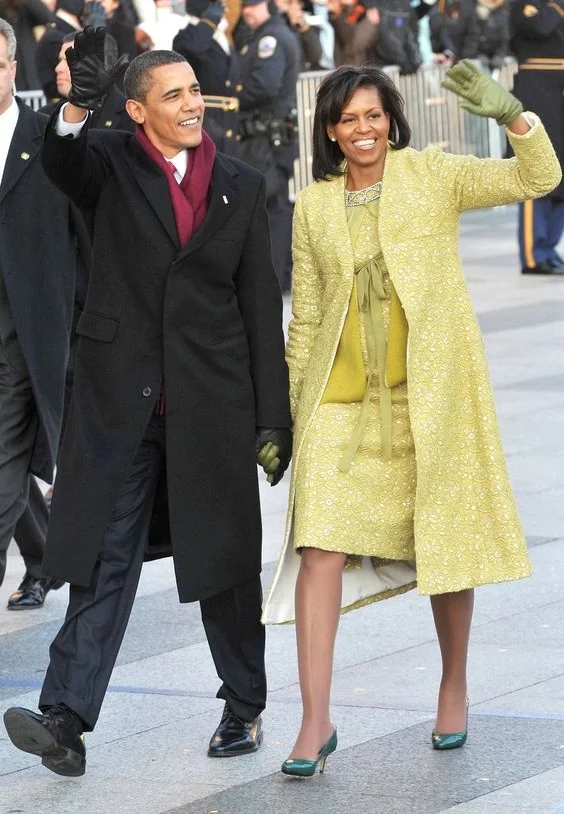
The Obamas at his Inauguration in 2009.
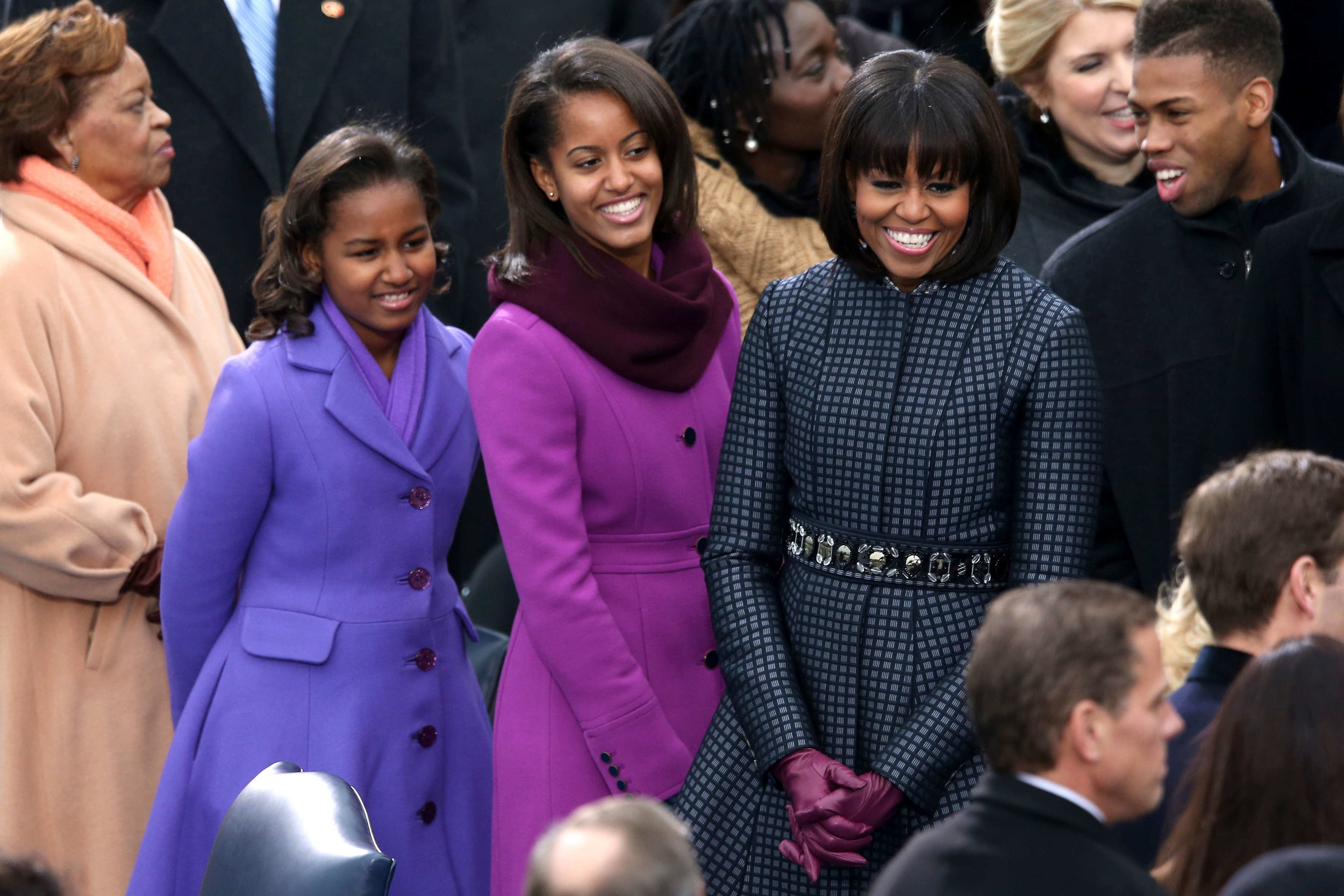
Mrs. Obama with her daughters at her husband's Inauguration in 2013.
Maybe it's because I want to see it, to find something positive about this miserable day and the gut-wrenching Presidential ascension of a man whose behavior would have gotten him fired from basically any other job in this country instead of an experienced, resilient woman (who also wore Ralph Lauren today) succeeding a leader of such dignity and intelligence, but Michelle and Melania gave me a twinge of hope, which, as I looked closer, sartorial details seemed to support. It was not just Melania's suit, but also her gloves and shoes that were icy blue. The jacket has an enveloping high neck. Her diamond earrings reflect and appear the same color as her gloves. It's unilaterally, unequivocally blue, while if you look closely, Michelle's burgundy has flecks of navy, as well as navy trim around the collar and sleeves. Burgundy is the general impression, but it's a patchwork of colors creating it.
For a woman wrapping up her tenure, the crew-style top and short sleeves evoke a readiness to get to work, which is, of course, what we all need to do. And Melania seems, in, albeit, a quiet way, to want to help. With this outfit, she's fully accepting her supportive public role yet intimating that her own private opinions can differ from her husband's. I hope I'm right.

IN WHICH DFW & I EXPLORE CHINESE BEAUTY APP MEITU
The IPO of Chinese "Aspirational Beauty App" Meitu is an irresistible conflux of innovation, glamour, and recursion--straight from the pages of Infinite Jest.
Welcome screens from the Meitu app.
I am not the first to gape at the remarkable prescience of David Foster Wallace's largely standalone conceit on the rise and fall of videophony buried inside Infinite Jest. But with the IPO of Chinese "Aspirational Beauty App" Meitu all over the New York Times and Fortune etc. it was such an irresistible conflux of innovation, glamour, and recursion I couldn't forgo the opportunity to explore it a little bit.
If you cobble together some extracts from the Meitu IPO coverage vs. Infinite Jest, it's almost impossible to discern fact from fiction, which is, of course, the purpose of the app itself. Try identifying the sources of these four quotations: Meitu, a (1)"High-def mask-entrepreneur," (2)"allows users to aggressively retouch their faces in photos," for (3)"aesthetic enhancement--stronger chins, smaller eye-bags, air-brushed scars and wrinkles." (4)"A touch can taper your jaw. It can slim your cheeks. Widen your eyes. Of course, it can make you thinner." It runs together seamlessly, but only (2) and (4) are from the news (Fortune and the NYT respectively). (1) and (3) are from Infinite Jest, published in 1996.
Obviously I had to download Meitu and try it. (Is the app's name intentionally an English homonym for "me too"?)
"Get ready for a new you!" the first screen instructs, followed by, in what seems to me a more foreboding admonition than intended, "Get ready for hundreds of emotions!" I found the original color version of my LinkedIn photo, which I consider to be, you know, a pretty good photo of myself, uploaded it to the app, and started tinkering.
Original photo (left) and Meitu-ized version (right)
There was something almost apotheotic about the ability to make pores evaporate, slim down my face, and up the ratio of eyes-to-nose. The whole process took about 30 seconds. It was terrifying, but mesmerizingly so, even if I found the results strange and alien-like--the aesthetics, by default, lean small-woodland-creature. I couldn't help but wonder, if the tweaks were geared toward American beauty standards rather than Chinese, if I would have felt differently. Per the NYT article, this is very much in the works--and will be more or less automated via geolocation usage algorithms. I shudder with "videophonic stress" and vanity--not hundreds of emotions, only two--just thinking about it, about expectations moving from Kim Kardashian to Bambi.
Meitu can "reject[] the idea that its business model relies on people’s insecurities or cultural pressures" and insist "It’s about making you happy," but I don't buy it. In the most flattering light I can muster, it's about getting caught up in DFW's "storm of entrepreneurial sci-fi-tech enthusiasm." Without a filter, of course, it's about Meitu making $$$. Precisely, $629M in the Hong Kong IPO this week and a $4.6B valuation. If DFW's clairvoyance holds, it will be a short-lived boom. Meitu already fell short its target $5B valuation, per the Wall Street Journal. "The question is whether the world wants Meitu’s idea of beauty," the NYT notes. But when innovations are rejected and their markets collapse, there can still be sticky effects:
"Even then, of course, the bulk of U.S. consumers remained verifiably reluctant to leave home and teleputer and to interface personally, though this phenomenon’s endurance can’t be attributed to the videophony-fad per se, and anyway the new panagoraphobia served to open huge new entrepreneurial teleputerized markets for home-shopping and -delivery, and didn’t cause much industry concern."
As a business and innovation strategy consultant, I'm no luddite and have few objections to companies making money. Personally, I also love a good Instagram filter. But Meitu just feels different; using it, I'd crossed one of those invisible lines that you know when you see. I deleted the app immediately.