
a. natasha joukovsky
journal

INAUGURATION 2017: SARTORIAL SUBTEXT
If you crop out Donald, it's a moving, beautiful image. Two powerful women, an African American and an immigrant, embracing one another warmly, clad in the color family of the other's party.

The Obamas and the Trumps, Inauguration Day 2017.
Melania Trump's inauguration ensemble perhaps bore an even greater debt to Jackie Kennedy's than her RNC speech did to Michelle Obama's. The internet is a-flutter with comparisons; there would have probably been even more had Kellyanne Conway not showed up dressed as Paddington Bear.

Jacqueline and John F. Kennedy at his Inauguration, 1961.
It's a move reflective of her husband's campaign's nostalgic overtones and an aggressively "I'm-the-first-lady"-looking look, and yet--intentionally, I hope--her choice can also be interpreted as an olive branch, and perhaps even subversive.
Jackie Kennedy was a democrat whose famous powder-blue suit perfectly matched her husband's tie; collectively they recognized yet muted the traditional blue of their party in the act of becoming President and First Lady of the entire American populace.
In contrast, Donald wore unadulterated Republican/MAGA red--and as a republican First Lady, the same powder blue carries different connotations. I'd read Melania's Ralph Lauren more as a Declaration of Independence from her husband if (in a coordinated effort that just had to be intentional) Michelle Obama wasn't wearing burgundy in contrast to President Obama's traditional, Democratic blue tie.

Mrs. Obama and Mrs. Trump today.
It has to be said that if you crop out Donald, it's a moving, beautiful image. Two powerful women, an African American and an immigrant, embracing one another warmly, clad in the color family of the other's party. It gives a sense of respect without deference, of a unified appeal for unity. They ooze FLOTUS glamour. It's worthy of the cover of Vogue.
It's also a sentiment that echoes Michelle's choices for both of her husband's own inaugurations. She wore yellow--the third, and only neutral, primary color--in 2009, and, along with her daughters, shades of violet in 2013--the secondary product of mixing red and blue.
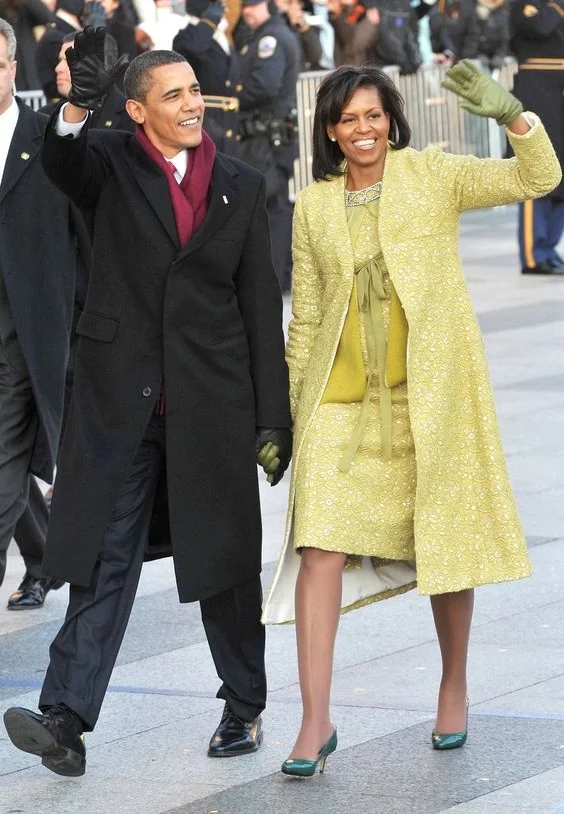
The Obamas at his Inauguration in 2009.
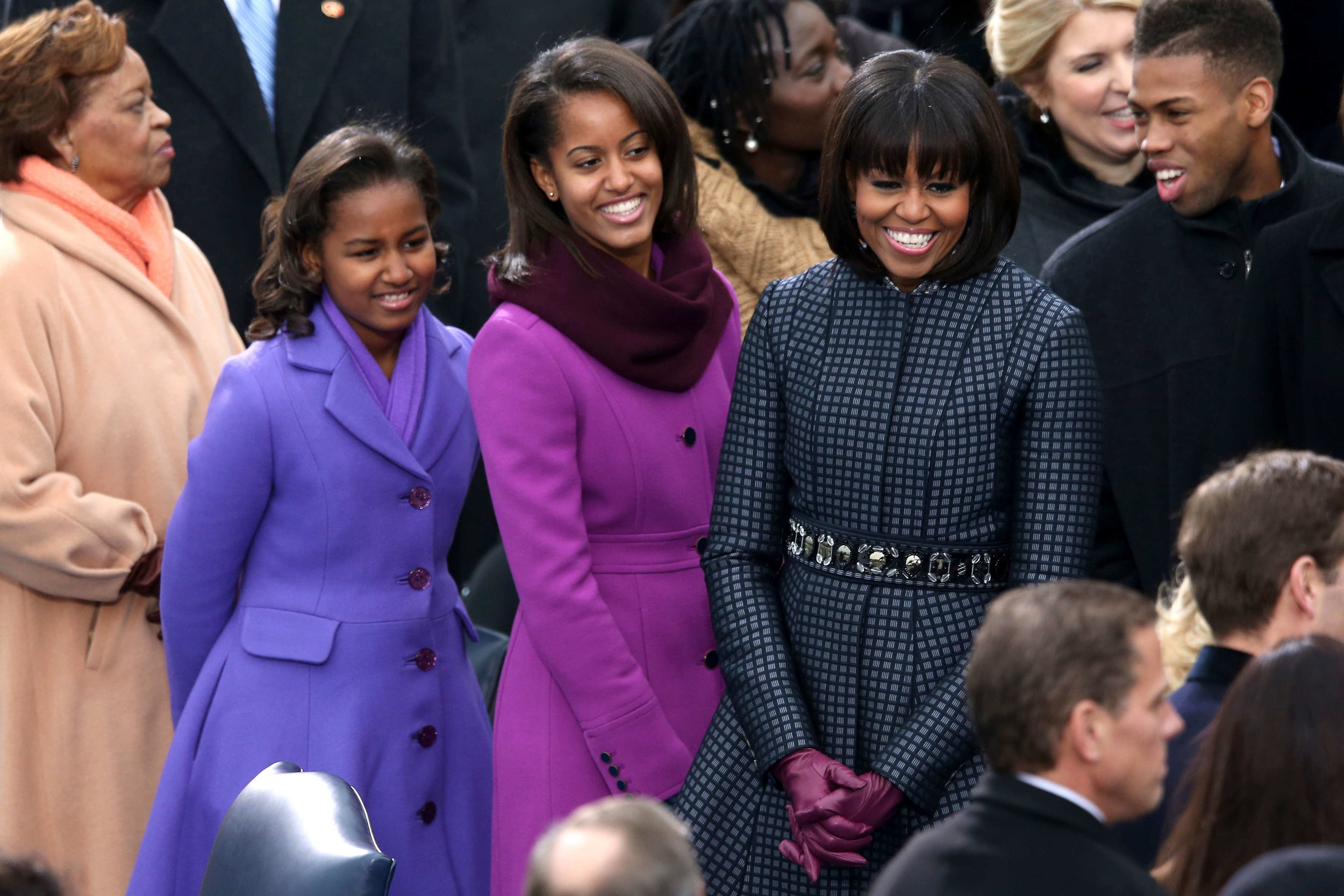
Mrs. Obama with her daughters at her husband's Inauguration in 2013.
Maybe it's because I want to see it, to find something positive about this miserable day and the gut-wrenching Presidential ascension of a man whose behavior would have gotten him fired from basically any other job in this country instead of an experienced, resilient woman (who also wore Ralph Lauren today) succeeding a leader of such dignity and intelligence, but Michelle and Melania gave me a twinge of hope, which, as I looked closer, sartorial details seemed to support. It was not just Melania's suit, but also her gloves and shoes that were icy blue. The jacket has an enveloping high neck. Her diamond earrings reflect and appear the same color as her gloves. It's unilaterally, unequivocally blue, while if you look closely, Michelle's burgundy has flecks of navy, as well as navy trim around the collar and sleeves. Burgundy is the general impression, but it's a patchwork of colors creating it.
For a woman wrapping up her tenure, the crew-style top and short sleeves evoke a readiness to get to work, which is, of course, what we all need to do. And Melania seems, in, albeit, a quiet way, to want to help. With this outfit, she's fully accepting her supportive public role yet intimating that her own private opinions can differ from her husband's. I hope I'm right.

RAPID-PROTOTYPING LIFE
We are all the end-users of our own lives, but what we think we want often turns out to be different from what we actually want. I decided to test a few things before going into the next round of production.
When my husband and I started talking this past summer about going on a "sabbatical" of sorts for a few months I was deep into an ilab project for a client and couldn't help thinking about our potential leave in the language of innovation.
The advantages of rapid prototyping in the context of business and technical innovation are well-documented, the biggest perhaps being the ability to test end-user reaction without the up-front investment to actually create the product or service. What you're creating with a prototype is, essentially, a simulacrum of the product or service--something that seems real, mimicking at least one aspect of the real product or service you'd like to test--but is actually just a shell of the real thing that is faster, cheaper, and easier to produce.
One big challenge with rapid prototyping is that there tends to be an inverse correlation between ease of prototypability and the stakes involved. In general, the bigger the investment the actual product or service will require, the harder it is to get people to try to simulate and test it. It's a lot easier to prototype, say, a digital app than a nuclear power plant, so we're often inclined to prototype the app but just take our best guess on the power plant, even though the consequences of making a bad decision re: the power plant are like to be astronomically harder and more expensive to correct downstream.
I spend a lot of time trying to convince people that it is worth the effort to try and prototype the power plant; that--while you should absolutely prototype the app too--it's actually more important to prototype the power plant; that just because something is hard to prototype does not mean you can't or shouldn't try; that low-fidelity is infinitely better than no-fidelity.
Life--that is, where you live, in terms of city, neighborhood, and apartment/house--seems to have way more in common with the power plant. Decisions tend to be long-term, expensive-to-get-out-of, and difficult to try-before-you-buy--it's something, in short, we should absolutely make the effort to prototype but almost never do. It usually takes years if you want to "try out" a few different cities in any meaningful way. No one lets you live in an apartment for a few weeks before you decide whether you want to rent or buy it (kind of a cool idea though). Decisions are often highly-influenced by glamour--by persuasive cognitive illusion.
We are all the end-users of our own lives, but what we think we want often turns out to be different from what we actually want.


I was excited to try it, to rapid-prototype life before making any kind of long-term decision. My husband and I factored in a few weeks of designated "vacation" time into the sabbatical, but built in three month-long stays. A month is long enough to really "live" somewhere vs. traveling; it's long enough to have days where you want to do precisely nothing and, perhaps more importantly, days where you will have to do things you don't want to do (e.g., laundry, grocery shopping). It's long enough to strip the glamour from a place and see it for what it really is. But it's short enough that, if you see something you really don't like, you don't have to live with it for too long; it's short enough to log these preferences and try to correct them fairly quickly in the next monthly iteration. We spent a month in (1) a rural town - Belfast, Maine, (2) a small-mid-size city - Nice, France, and (3) a non-NYC big city - Paris, France. Simultaneously, we experienced living in (1) a residential neighborhood, (2) an "old city" pseudo-residential neighborhood, and (3) a primarily commercial neighborhood, and (1) a huge house, (2) a studio even smaller than what we had in NYC, and (3) a very spacious one-bedroom apartment.
It was low-fidelity, of course. Life is just different when you don't have a day job, and while I spent a fair amount of time writing, we didn't really even try to control for this. Not working is kind of the point of a sabbatical. We definitely did some touristy things outside of designated vacation time.
But even so, in terms of developing a more informed perspective, a deeper personal understanding of what I want in a city/town, a neighborhood, and an abode, I think the experiment resoundingly supported my ongoing hypothesis that a low-fidelity prototype is way better than no prototype at all. I now know, for instance, that I infinitely prefer having a washing machine but no dryer inside an apartment to having both in a communal space shared by the building. I care more about specific neighborhood than greater city. Light and views matter a lot. Size, less than I would have thought (mess, like work, expands to fill the space you allow it), but it is important to have at least one very comfortable, cozy place.
We're leaving Paris tomorrow, and I have no regrets. I recognize how unusual it is and fortunate we were to be able to do something like this, but for anyone who can, I highly recommend it.

IN WHICH DFW & I EXPLORE CHINESE BEAUTY APP MEITU
The IPO of Chinese "Aspirational Beauty App" Meitu is an irresistible conflux of innovation, glamour, and recursion--straight from the pages of Infinite Jest.
Welcome screens from the Meitu app.
I am not the first to gape at the remarkable prescience of David Foster Wallace's largely standalone conceit on the rise and fall of videophony buried inside Infinite Jest. But with the IPO of Chinese "Aspirational Beauty App" Meitu all over the New York Times and Fortune etc. it was such an irresistible conflux of innovation, glamour, and recursion I couldn't forgo the opportunity to explore it a little bit.
If you cobble together some extracts from the Meitu IPO coverage vs. Infinite Jest, it's almost impossible to discern fact from fiction, which is, of course, the purpose of the app itself. Try identifying the sources of these four quotations: Meitu, a (1)"High-def mask-entrepreneur," (2)"allows users to aggressively retouch their faces in photos," for (3)"aesthetic enhancement--stronger chins, smaller eye-bags, air-brushed scars and wrinkles." (4)"A touch can taper your jaw. It can slim your cheeks. Widen your eyes. Of course, it can make you thinner." It runs together seamlessly, but only (2) and (4) are from the news (Fortune and the NYT respectively). (1) and (3) are from Infinite Jest, published in 1996.
Obviously I had to download Meitu and try it. (Is the app's name intentionally an English homonym for "me too"?)
"Get ready for a new you!" the first screen instructs, followed by, in what seems to me a more foreboding admonition than intended, "Get ready for hundreds of emotions!" I found the original color version of my LinkedIn photo, which I consider to be, you know, a pretty good photo of myself, uploaded it to the app, and started tinkering.
Original photo (left) and Meitu-ized version (right)
There was something almost apotheotic about the ability to make pores evaporate, slim down my face, and up the ratio of eyes-to-nose. The whole process took about 30 seconds. It was terrifying, but mesmerizingly so, even if I found the results strange and alien-like--the aesthetics, by default, lean small-woodland-creature. I couldn't help but wonder, if the tweaks were geared toward American beauty standards rather than Chinese, if I would have felt differently. Per the NYT article, this is very much in the works--and will be more or less automated via geolocation usage algorithms. I shudder with "videophonic stress" and vanity--not hundreds of emotions, only two--just thinking about it, about expectations moving from Kim Kardashian to Bambi.
Meitu can "reject[] the idea that its business model relies on people’s insecurities or cultural pressures" and insist "It’s about making you happy," but I don't buy it. In the most flattering light I can muster, it's about getting caught up in DFW's "storm of entrepreneurial sci-fi-tech enthusiasm." Without a filter, of course, it's about Meitu making $$$. Precisely, $629M in the Hong Kong IPO this week and a $4.6B valuation. If DFW's clairvoyance holds, it will be a short-lived boom. Meitu already fell short its target $5B valuation, per the Wall Street Journal. "The question is whether the world wants Meitu’s idea of beauty," the NYT notes. But when innovations are rejected and their markets collapse, there can still be sticky effects:
"Even then, of course, the bulk of U.S. consumers remained verifiably reluctant to leave home and teleputer and to interface personally, though this phenomenon’s endurance can’t be attributed to the videophony-fad per se, and anyway the new panagoraphobia served to open huge new entrepreneurial teleputerized markets for home-shopping and -delivery, and didn’t cause much industry concern."
As a business and innovation strategy consultant, I'm no luddite and have few objections to companies making money. Personally, I also love a good Instagram filter. But Meitu just feels different; using it, I'd crossed one of those invisible lines that you know when you see. I deleted the app immediately.

DELPOZO, WESTWORLD, AND FUTURISTIC NOSTALGIA
Forget blinking buttons and spacesuits--the height of technical innovation is rather its own obfuscation.
Delpozo's recent SS17 collection bordered on transcendent: organic yet architectural, somehow simultaneously channeling both sci-fi futurism and Victorian nostalgia. They are the kinds of clothes one might imagine wearing to a formal ball hosted by Luke Skywalker or a rave with Anna Karenina. As Vogue nicely put it, "The resulting lineup was a bit Old World, yet undeniably modern; even the designer's most otherworldly proportions felt featherweight."
Delpozo SS17 - What to wear to a formal ball hosted by Luke Skywalker, or a rave with Anna Karenina.
Depozo SS17 - Equally appropriate for futuristic human technocrat and wild-western cyborg.
I thought a lot about Josep Font's creations this week as I watched the first three episodes of HBO's new series "Westworld"--and not just because many of his designs would seem equally appropriate on its human women and robot "hosts." If the end goal of technical innovation is immortality, a key implied requirement is the ability to inorganically mimic the organic. Forget blinking buttons and spacesuits--the height of technical innovation is rather its own obfuscation, an unnatural return to nature not so much for the purpose of passing a Turing test as rendering one obsolete in the inextricable blending of the two.
Based on Michael Crichton's 1973 theme-park-gone-wrong precursor to Jurassic Park but more like an extended sequel to 2015's Ex Machina, the new "Westworld" depicts an application of naturalistic technology aimed precisely at manufacturing pre-digital nostalgia into a highly-marketable recursive loop. It's a clever premise, appealing simultaneously to our fetishization of future and past, the glamour of immortality-seeking innovation and the glamour of the bloody Wild West in a way that, as Rolling Stone points out, feels very now. Perhaps that's because, according to Emily Nussbaum, what "Westworld" is really about is HBO today:
"Like HBO showrunners, Westworld’s designers “pitch” plot arcs. They “massage” story lines. They plant backstories to deepen characterizations. When glitches appear, they panic over the need to halt production, much as 'Westworld' itself did, when it shut down during shooting for a rewrite. They are uneasy, at times, about the ethics of their labor. In real life, 'Westworld' can’t just be good—it needs to be a hit, too. It’s HBO’s bid for a franchise to succeed 'Game of Thrones,' following two pricey flops, 'Vinyl' and 'True Detective.' For both the show and the show inside the show, the key is to reproduce the alchemy that HBO perfected when it slid the Bada Bing into 'The Sopranos'..."
Even from the opening credits to "Westworld"--a macro-lens tour through an über-stylized Vitruvian workshop of technical materials and human organs, eerily serenaded by a skeleton pianist who gives way to a player-piano--it's clear this show is HBO out-HBOing itself.
When I picture the showrunners, they too are wearing Delpozo SS17.